The Nemuri Breathwork Necklace — Relaxation On Demand
A battery-free pendant you breathe through. Its shaped air channel keeps the inhale easy and slows the exhale: the breathing pattern that calms your nervous system.
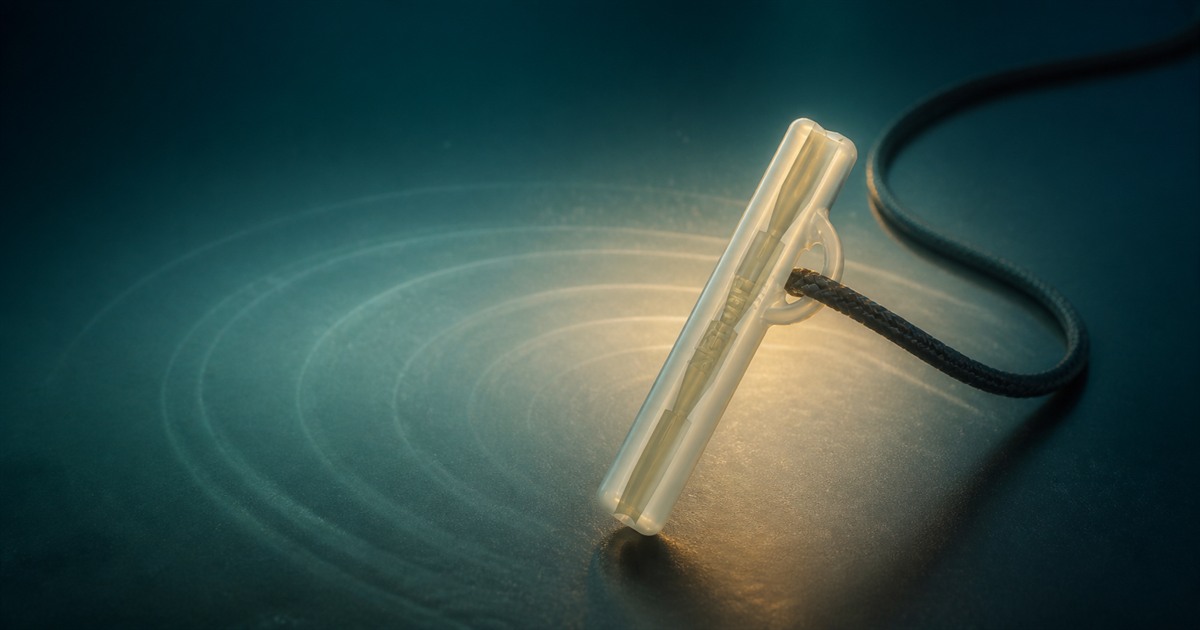
Get your Nemuri
$49.84 + shipping and any tax, shown before you pay
- No account needed: pay by card, PayPal, or Google Pay
- Printed and shipped from Europe
- Needs a quick hot-water rinse before first use (see how)
What the Nemuri is
Nemuri (眠り, Japanese for sleep) is a breathing tool you wear around your neck. It has no batteries, no Bluetooth, no app, and nothing to charge. You simply breathe through it.
The whole trick is the air channel inside. It's shaped so that breathing in is nearly effortless while breathing out meets a gentle, steady resistance. That slows and lengthens your exhale without you having to count or concentrate, which is exactly the breathing pattern that shifts your body toward "rest and digest." Within a minute or two, most people notice their shoulders drop and their breathing settle.
It's 3D printed in one piece from a semi-transparent ultra-fine plastic, so you can see the channel inside. It's about 7.4 cm long (just under 3 inches) and slim enough to disappear under a collar.
Spin it in 3D
Drag to rotate, and scroll or pinch to zoom. This is the real print-ready model, the same geometry Thangs prints for you.
🛒 How to order your Nemuri on Thangs
Every Nemuri is now printed and shipped by Thangs, a 3D-printing marketplace. The listing offers two different things, so pick the right one:
- Open the Nemuri on Thangs using any "Order on Thangs" button on this page. It opens in a new tab, so these instructions stay here.
- Click "Order your 3D print" to open the print option. The digital download is shown first, so look just below it.
- Click "Buy now" (or "Add print to cart"), enter your shipping address, and pay by card, PayPal, or Google Pay. You don't need a Thangs account.
- Price: $49.84 for the pendant. Shipping and any sales tax are calculated from your address and shown before you pay.
- Shipping: it's printed and shipped from Europe. When we checked, Thangs estimated about two weeks to the U.S. Depending on your country, import fees or taxes may be collected on delivery.
- Order questions (tracking, delivery, a damaged parcel) go to Thangs, since they print and ship it. Questions about using your Nemuri? Ask us.
Melt out the leftover wax
To print an air channel this intricate, the printer fills the hollow inside with a wax support material while it builds the pendant layer by layer, so the channel keeps its exact shape. That's how intricate 3D prints like this are made. The Nemuri arrives from Thangs only partly processed, so some of that wax can still be sitting inside the channel. Clearing it takes a few minutes and a kettle:
- Boil some water. A kettle is easiest.
- Pour it through and around. Hold the Nemuri with tongs over the sink (or stand it in a heat-safe mug) and slowly pour the just-boiled water through the channel and all over the outside.
- Shake it in the hot water. Drop it into a mug of the very hot water and swirl and shake it around quickly. The heat melts the wax out of the inside and the motion flushes it through. Keep it brief: don't leave it sitting in boiling water.
- Check, and repeat if needed. Pour off the water and blow through the channel. If you still see cloudy or waxy bits, or the airflow feels blocked, do it once more with fresh hot water.
- Rinse and let it cool. Rinse with warm tap water and let it cool and dry completely before it goes near your lips.
Careful: boiling water burns fast. Use tongs or a slotted spoon, never your fingers, and keep children away while you do this.
🌬️ How to use it
Lift it to your lips, close them gently around the mouthpiece, and breathe through it slowly and naturally. Most people fall into a 4-seconds-in, 6-seconds-out rhythm within the first few breaths. After about 90 seconds you'll feel the shift: a softening in the chest, a longer exhale, a quieter mind. To go deeper, let the exhale run even longer and let your shoulders drop on every out-breath.
Three sessions a day of two to five minutes each is plenty to start retraining your everyday breathing. People use it before meetings, on commutes and flights, before sleep, and after hard conversations. It's quiet and discreet; nobody around you needs to know what you're doing.
Go gently. If you feel lightheaded or dizzy, take it away from your lips and breathe normally. Don't use it while driving or doing anything where feeling lightheaded would be dangerous.
🔬 The science: a "reverse venturi"
The entire effect of the Nemuri lives in a channel you can't see from the outside. Here's exactly what happens inside the pendant when you breathe through it.
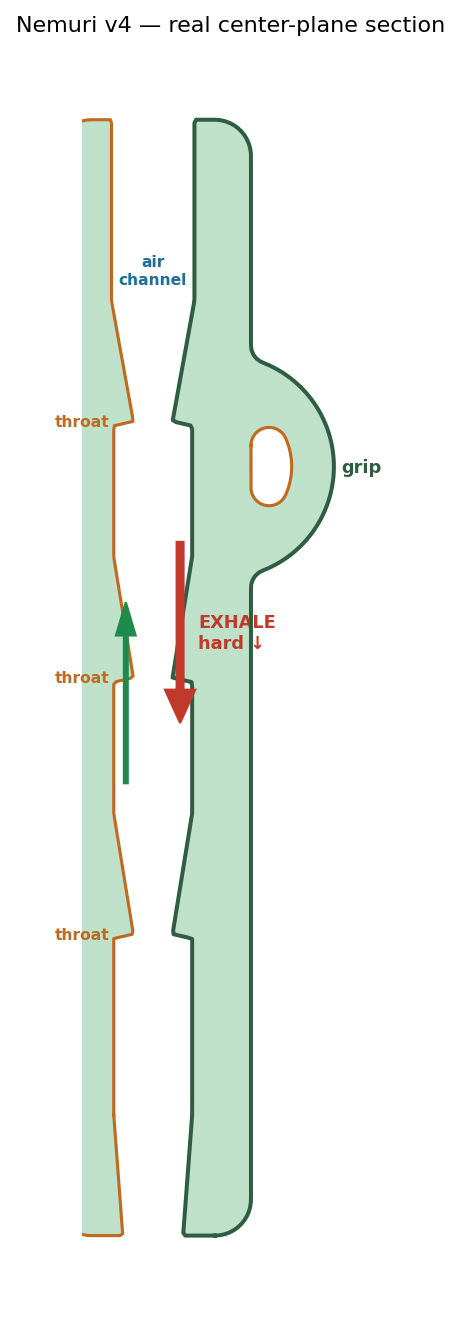
A true cross-section sliced from the 3D model. Air enters at the top, travels down the channel, and exits at the bottom. The channel pinches inward at three points, and those pinches are the engine of the device.
What a venturi is
A venturi is a channel that narrows to a throat and then widens again. When air is forced through the narrow throat it has to speed up, and (by Bernoulli's principle) its pressure drops at the throat. The smoothly widening section afterward, a diffuser, lets the flow slow back down and recover most of that pressure instead of crashing into turbulence.
The Nemuri borrows the same geometry for a different purpose: to add a small, exact amount of resistance to the breath. The throat is the restriction, and the resistance you feel on your lips is the pressure it takes to push air through it. Nemuri's throat is tuned to about 2.6 mm: enough to feel, never enough to strain.
The "reverse" part: why inhaling is easy but exhaling is work
A plain venturi resists air equally in both directions. The Nemuri doesn't. Each of its three throats is asymmetric, with a smooth funnel on the mouth side and an abrupt step on the exit side. That asymmetry makes the channel act like a passive one-way valve for pressure (a fluidic diode) with no moving parts:
- Inhaling is easy. Air meets each throat as a smooth contraction (a nozzle: it accelerates cleanly, with almost no loss) and flows out through a gentle diffuser that hands the pressure back. The path is streamlined, so inhaling is nearly effortless.
- Exhaling is deliberately harder. Going the other way, the air rushes through the throat and hits a sudden expansion, a sharp shoulder it can't follow. The jet separates and tumbles into turbulence, and that turbulence burns off energy (a Borda–Carnot expansion loss). It then takes more pressure to move the same air, so the exhale meets real, felt resistance.
Because three of these asymmetric throats are stacked in series, the effect compounds to roughly a 2 : 1 ratio: your exhale meets about twice the resistance of your inhale. It's entirely passive and valveless, the same principle used in valveless micro-pumps and conceptually related to the Tesla valve.
In one sentence: the Nemuri lets you breathe in freely and gently slows you down on the way out, automatically, with nothing but the shape of the air channel.
Why that difference matters to your nervous system
"Easy in, slow out" is precisely the breathing pattern that calms the body, and the Nemuri produces it for you:
- A longer exhale raises vagal tone. Your heart rate naturally falls on the out-breath (respiratory sinus arrhythmia). Lengthening and resisting the exhale strengthens that signal and shifts you toward parasympathetic "rest and digest."
- It settles you into the resonance zone. Resisted exhalation naturally slows breathing toward about 4–6 breaths per minute, the "coherent breathing" range where heart-rate variability and the calming baroreflex are strongest.
- The easy inhale is what makes it sustainable. If inhaling were also hard, you'd feel air-hungry and fight the device. Because the inhale is nearly effortless, you can refill quickly and hold a long, slow exhale, session after session, without strain.
- Gentle pressure feedback on the lips, plus the pursed-lip style of breathing, gives your body a soft, physical cue to slow down.
New to all this? Our Getting Started guide explains the vagus nerve in plain English, and the 2-minute vagus check shows whether your symptoms point to it.
Nemuri is a breathwork and wellness tool, not a medical device; it supports healthy breathing habits and is not intended to diagnose or treat any condition.
✨ The design
Clean engraving front and back: Nemuri on the face and 眠り (Japanese for sleep) on the reverse.
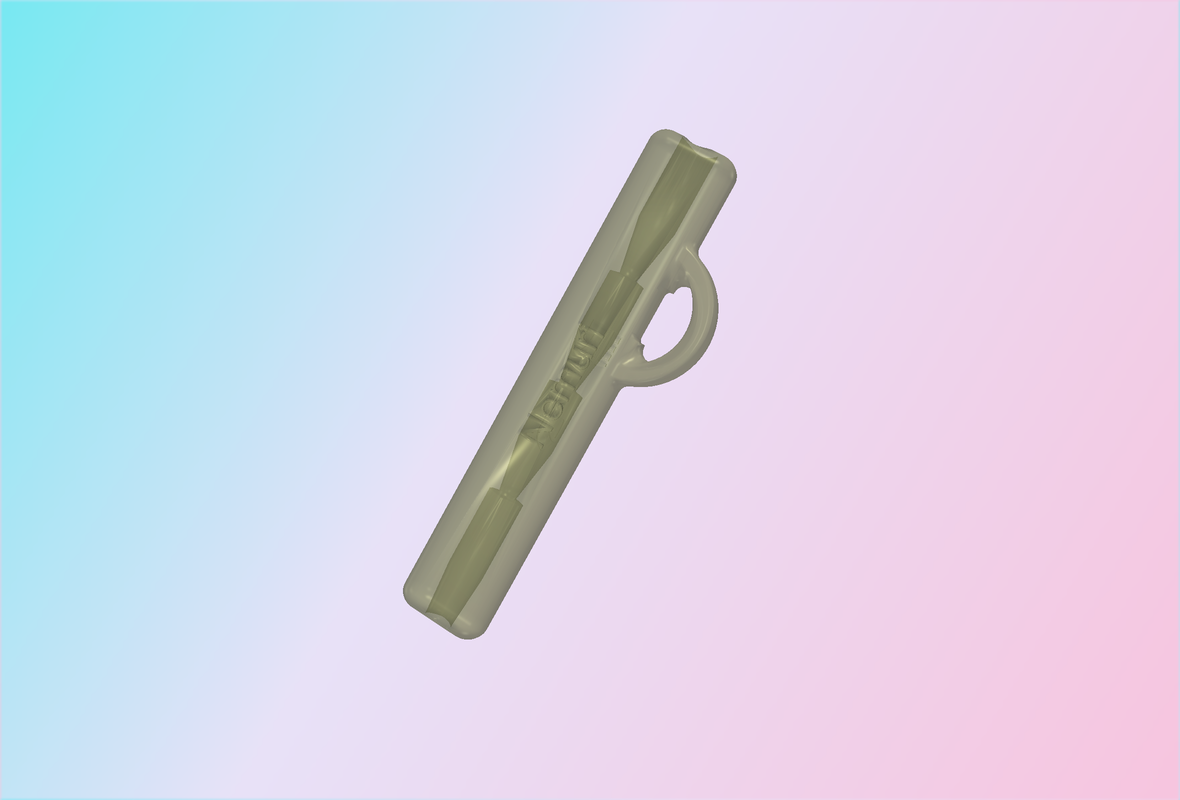
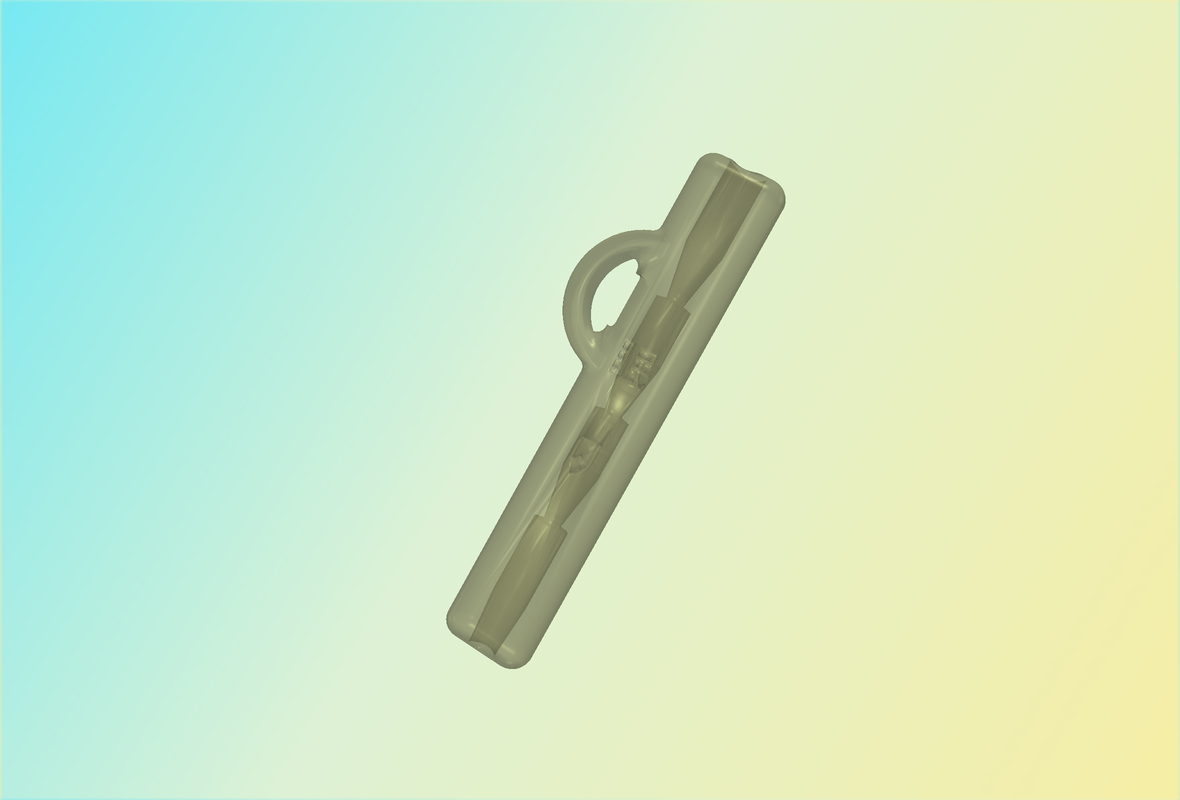
Renders of the print model. The pendant from Thangs is the semi-transparent version.
A real chain fits
The side loop is full thickness, flush with the body, and rounded at every junction so there are no weak points to snap. The inside of the loop is opened up so a satin cord, jump ring, or metal chain link passes through with room to spare.
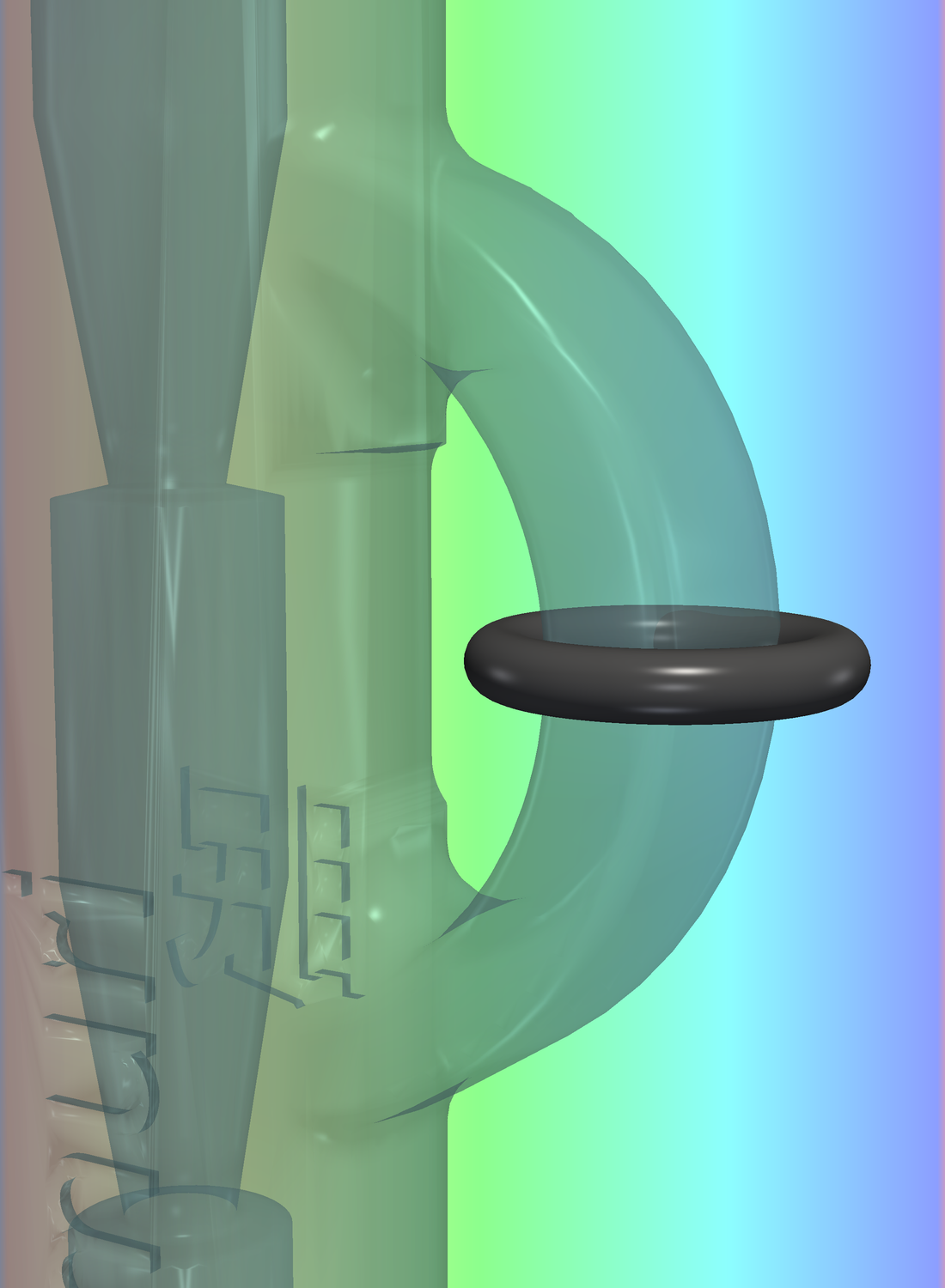
The side loop up close: a chain link threads cleanly through.
Care
After the first-use wax rinse above, everyday care is simple: rinse the channel with warm water after use, and about once a week soak it for a couple of minutes in mild soapy water, then rinse again. Avoid harsh solvents and ultrasonic cleaners. With no electronics, seals, or batteries, there's nothing to wear out, and a Nemuri should last for years with basic care. Please don't share a mouthpiece without cleaning it first.
⭐ Nemuri reviews
No reviews yet. Got your Nemuri? Be the first to tell people how it's working for you.
Write a review
Ready to slow your breathing down?
$49.84 on Thangs. Choose "Order your 3D print", and remember the hot-water rinse before first use.
Order your Nemuri on Thangs →